

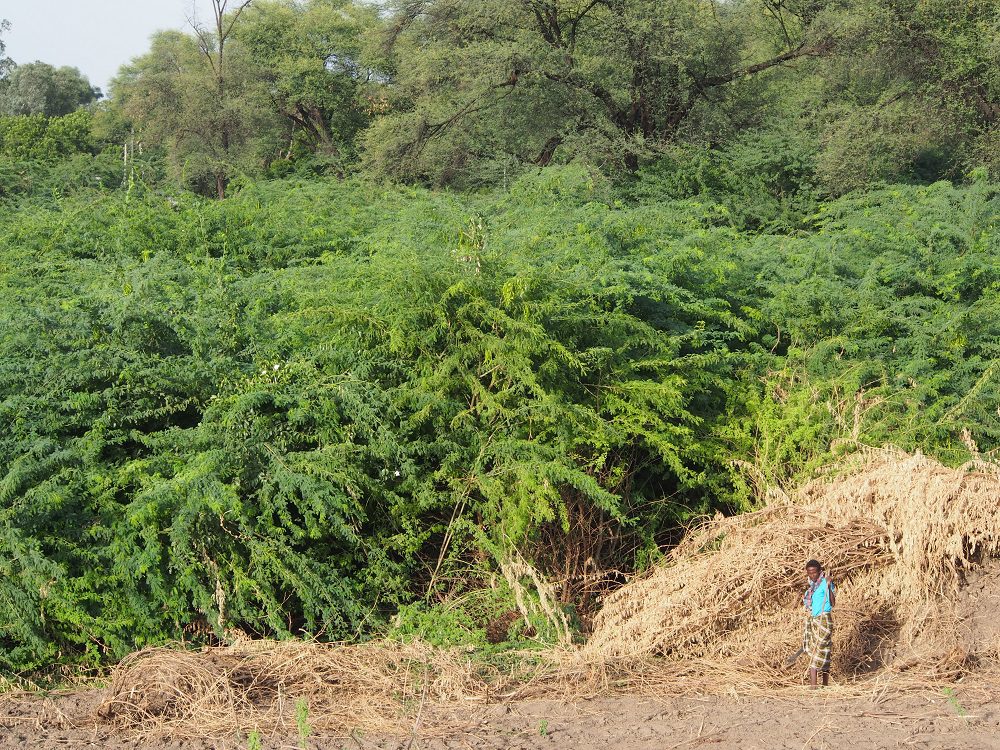
Prosopis juliflora—locally known as Garanwaa is one of the most invasive and fast-spreading shrubs in Somaliland and the Horn of Africa. It now covers an estimated 1.5 million hectares of rangeland and farmland, reducing grazing productivity by up to 60%. Initially introduced for soil conservation, it has since turned into a serious ecological threat, dominating natural pastures, blocking farm access and competing for underground water.
Yet, when approached strategically, Prosopis can become an economic and nutritional asset. At Holistic Livestock Solutions (HLS), we promote a practical “Manage – Use – Control” strategy that turns this invasive shrub into a resource for farmers and pastoral communities.
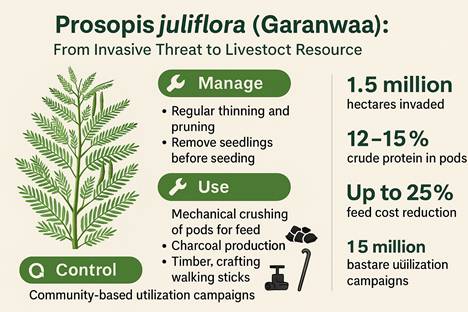
🌾 HLS Three-Pillar Control Strategy
1️⃣ Manage
- Regular mechanical thinning and pruning to prevent uncontrolled spread.
- Removal of seedlings before seeding and re-planting cleared areas with Buffel grass, Sudan grass, or Desmodium to restore pasture.
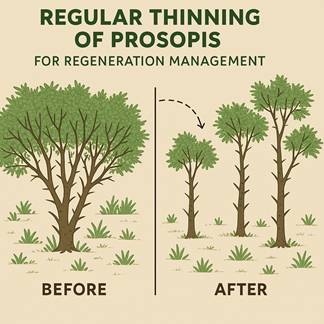
Regular mechanical thinning and strategic pruning of Prosopis stands should be done continuously to prevent uncontrolled spread and reduce canopy dominance. This includes cutting back overgrown branches, selectively removing densely infested patches and opening grazing corridors so livestock and equipment can move freely. Thinning also reduces shading, increases sunlight penetration and improves ground grass cover response after rains. Mechanical control must be done at least once or twice per year depending on re-growth speed and rainfall.
In addition to pruning, all newly emerging Prosopis seedlings should be actively removed at early stages before seed set. Early-stage uprooting is faster, cheaper and more effective than dealing with mature trees later. Cleared areas should not be left bare, this accelerates re-invasion. Immediately after clearing, the area should be re-seeded or re-planted with desirable drought-tolerant pasture species such as Buffel grass (Cenchrus ciliaris), Sudan grass (Sorghum sudanense), or Desmodium species. These species form a competitive vegetative cover that suppresses Prosopis re-germination, improves soil health, increases forage biomass and restores grazing value.
The combination of mechanical thinning + seedling removal together with immediate reseeding creates a sustainable restoration cycle that gradually shifts the rangeland from Prosopis dominance to productive pasture suitable for livestock fattening, dairy systems and range-based grazing production systems.
FAQ: Regular thinning of prosopis
2️⃣ Use
Transform the plant’s biomass and pods into valuable by-products:
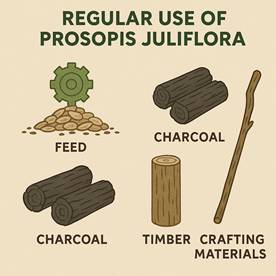
- Mechanical Crushing of Pods for Feed Supplementation– Prosopis pods can be mechanically crushed, ground, or pelleted and incorporated into livestock rations. With a crude protein content ranging between 12–15% and TDN of 60–65%, the pods provide a cost-effective energy and protein source for cattle, goats, sheep and even camels. When properly mixed with molasses, bran or oilseed cakes, crushed Prosopis pods can substitute part of the commercial concentrate, reducing feed cost significantly during dry seasons. Community-scale hammer mills or feed processing units can be established near infested rangelands to unlock this feed resource for smallholder farmers.
- Charcoal & Fuelwood Production for Income Generation-The mature stems of P. juliflora are hard and have high calorific value, making them excellent for charcoal and firewood. In many semi-arid regions, controlled harvesting for fuelwood not only supports rural households with energy needs, but also creates a marketable product. Women and youth groups can organize into producer groups to supply charcoal to local towns and peri-urban markets, contributing to livelihood diversification while at the same time reducing the invasive spread.
- Timber and Crafting Materials-Prosopis wood is strong, durable and termite-resistant. Its branches are ideal for making fencing poles, traditional house frames, walking sticks, tool handles, and simple furniture. Local artisans and carpenters can transform these materials into high-value craft products, stimulating micro-enterprise and creating employment opportunities within the community.
- Strengthening Livestock Feed Economics and Rural Enterprise-When fully utilized through pod crushing, controlled harvesting and value-added products, P. juliflora becomes a productive resource rather than a threat. Studies and field experiences show that integrating Prosopis pod meal into livestock diets can reduce total feed costs by up to 25%, especially for cattle and goat fattening systems. Combined with charcoal, timber and artisanal crafts, Prosopis management can evolve into a rural enterprise pathway, supporting income generation, lowering costs for livestock keepers and creating sustainable economic alternatives for pastoral communities.
FAQ: Regular use of Prosopis Julifora
3️⃣ Control
- Community-Based Utilization, Capacity Building & Institutional Support–Community-Based Utilization and Managed Stands-Organizing communities into joint management groups can transform dense Prosopis thickets into controlled, productive stands. Through collective harvesting, controlled cutting and rotational use systems, communities can turn Prosopis from an invasive challenge into a regulated resource. Community bylaws, user rights agreements and shared benefit mechanisms help prevent conflict, ensure equitable access and maintain sustainability. Managed Prosopis stands can be zoned for pod harvesting, fuelwood extraction and craft timber while protecting rangelands from re-infestation.
- Training & Farmer Skills Development-Building farmer capacity is critical. Farmers should be trained in safe pod collection, hygienic handling, crushing and proper feed mixing procedures that prevent digestive disorders and toxicity risks. Training modules can include:
- pod harvesting timing
- drying and storage
- pod grinding or crushing using hammer mills
- inclusion rates in cattle, camels, goats and sheep rations
- balancing rations with other protein and energy sources
Such skills empower households to reduce feed costs, improve ration quality and boost livestock productivity without depending entirely on expensive commercial concentrates. - Institutional Partnerships & Policy Integration-Close collaboration with local councils, village committees and environmental agencies enables Prosopis utilization to be integrated into wider rangeland restoration and invasive species control strategies. Government bodies can allocate resource use zones, provide guidelines, enforce sustainable cutting practices and link community initiatives with district/regional development plans. Integration into national rangeland rehabilitation programs also unlocks support for seedling replacements with desirable pasture species, carbon credit pilots, research partnerships and private sector investments in small-scale feed processing clusters..
Current Initiatives Shaping the Region’s Prosopis Revolution
There are several initiatives in Somalia and the wider Horn of Africa that have pilot-tested the use of Prosopis juliflora as part of control and utilization efforts. In Somaliland, Lander Prosopis converts the invasive tree into “green charcoal” and other products, supporting land clearing and job creation. Ecosom similarly processes Prosopis and crop residues into clean-energy briquettes, reducing pressure on native woodlands. The UNDP Sustainable Charcoal and Alternative Livelihoods Programme introduced improved carbonization technologies and community training to promote Prosopis-based charcoal instead of cutting indigenous trees. Regionally, Kenya’s BORESHA programme trained communities in Prosopis charcoal and briquette production, providing workable lessons.
Across these efforts, Prosopis has been used to produce lump charcoal, briquettes, livestock feed from pods and biochar for soil improvement, alongside fuelwood and small timber products. Price records show that a 25-kg sack of charcoal in urban Somaliland has sold for around USD 14, while producer-level prices often range between USD 3–6 per sack, depending on transport, kiln efficiency and distance to markets. Although these prices apply broadly to charcoal, they represent the competitive range for Prosopis products.
Documented lessons emphasize the need for strong market linkages, as projects that paired technical training with buyer access achieved better outcomes. Improved kilns and briquetting technologies significantly increase efficiency and profitability. However, programmes note risks of perverse incentives, where high charcoal profitability could unintentionally encourage Prosopis spread without proper management. Finally, long-term success depends on policy support, community involvement and diversification into charcoal, briquettes, feed and biochar, ensuring both livelihood benefits and effective control of the invasive species.
This approach should discourage the cutting of other valuable plant species for charcoal and must strictly adhere to reforestation requirements to ensure sustainable ecosystem recovery.
🌍 Impact
Through this integrated approach, Prosopis juliflora is re-positioned from a destructive invader into a multi-purpose resource supporting livestock nutrition, rural livelihoods and ecological restoration, turning Garanwaa into a symbol of resilience and opportunity.


we deeply appreciate your innovation, contributions and dedication for the best control of prosopis that threats our main section of production
Thank you once again