
By: Farhan Ahmed Yusuf | Livestock Consultant | Founder, Holistic Livestock Solutions (HLS)|
| +252 63 8891055 |+252 634410129 | info@holisticlivestocksolutions.com |
Keywords
Livestock Value Chain, Livestock Productivity, Livestock Commercialization, Livestock Markets, Value Addition, Animal Nutrition, Livestock Processing, Market Access, Sustainable Livestock, Agribusiness, Food Security, Rural Development, Climate-Resilient Livestock, Livestock Investment, Livestock Trade.
Introduction
Livestock is a cornerstone of economic growth, food security and rural livelihoods in many developing countries. Yet millions of livestock producers continue to earn modest incomes despite rising demand for meat, milk and other animal products. The challenge is rarely production alone; it is the inefficiency of the livestock value chain. Weak links between producers, markets, processors and consumers prevent farmers from realizing the full value of their animals.
Transforming livestock systems requires moving beyond increasing herd sizes to building integrated value chains that enhance productivity, reduce losses and create value at every stage.
Where Farmers Lose Income
Poor Nutrition and Low Productivity
Feed is the largest cost in livestock production and the foundation of animal performance. Poor nutrition leads to slow growth, reduced fertility, lower milk yields and poor carcass quality, ultimately reducing market value. Investments in quality feed, improved pasture management and fodder conservation consistently generate strong returns.
Disease and Limited Animal Health Services
Preventable diseases continue to reduce productivity through mortality, poor growth and trade restrictions. Strong veterinary services, routine vaccination, disease surveillance, and farmer education are essential for protecting both livelihoods and national livestock industries.
Distress Sales and Weak Market Information
Many farmers sell animals during droughts or financial emergencies, often when prices are lowest. Limited access to reliable market information further weakens their bargaining position. Digital market information systems, producer cooperatives and better access to finance can help farmers sell strategically rather than out of necessity.
Limited Value Addition
In many countries, livestock are exported live while processed meat, fish, chicken meat, dairy products and leather goods are imported at much higher values. This represents a missed opportunity for employment, industrial growth and foreign exchange earnings. Expanding local processing of meat, milk, hides and skins allows countries to capture greater economic value from their livestock resources.
Building Efficient Livestock Value Chains
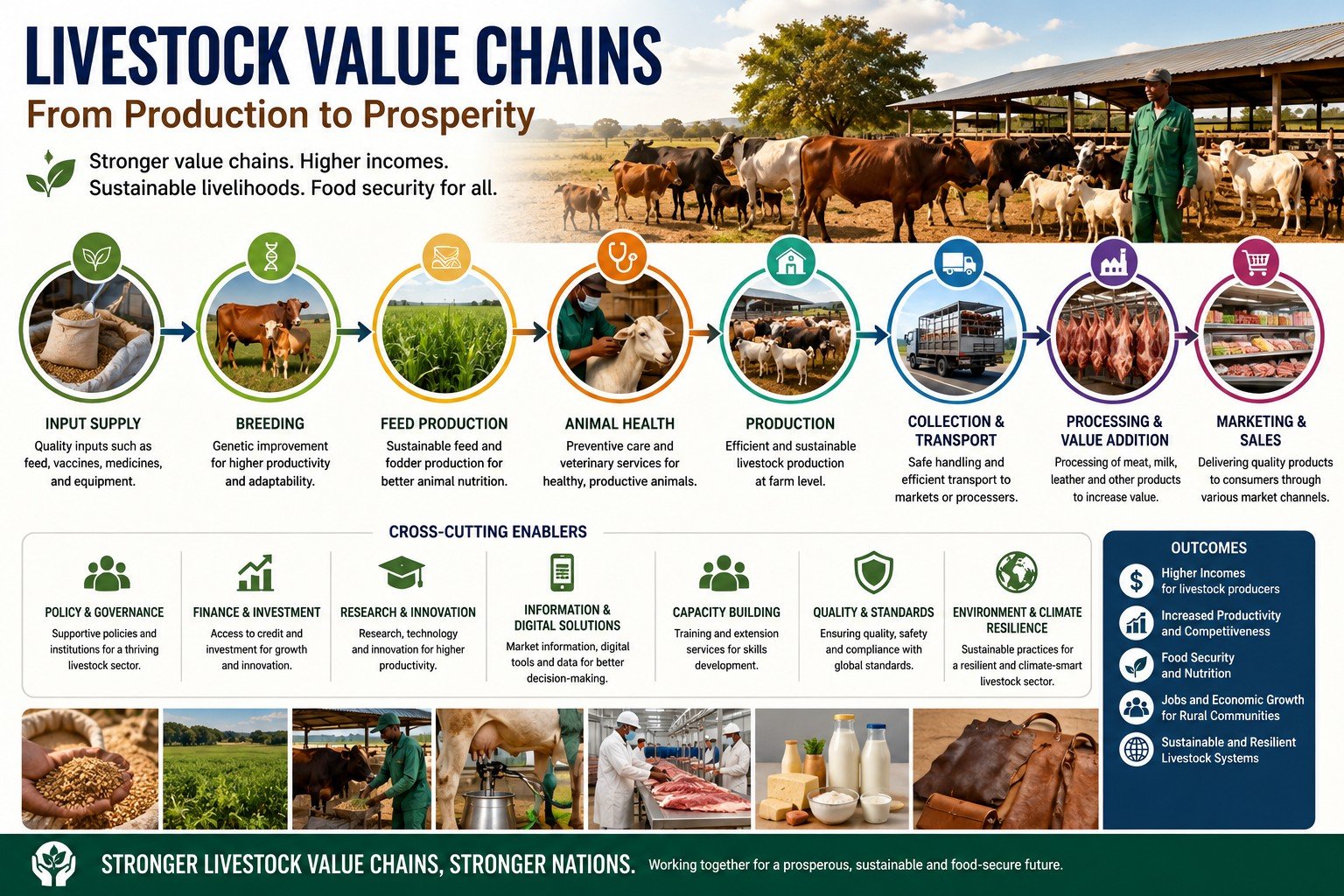
A competitive livestock sector depends on strong connections between all participants, including input suppliers, farmers, transporters, processors, traders, retailers and consumers. Governments and the private sector each have critical roles in strengthening these connections.
Priority investments include:
- High-quality feed production and pasture development.
- Accessible veterinary and extension services.
- Modern livestock markets and transport infrastructure.
- Cold chain and processing facilities.
- Market information and digital trading platforms.
- Producer organizations that strengthen farmers’ bargaining power.
When these components function effectively, productivity increases, post-harvest losses decline and farmers receive a larger share of the final market value.
The Role of Technology
Digital technologies are rapidly transforming livestock production and marketing. Electronic animal identification, traceability systems, mobile market platforms, precision feeding, remote disease surveillance, reliable financial infrastructure and digital payment systems improve efficiency, transparency and market access. These innovations also help countries meet international quality and food safety standards, expanding opportunities for regional and global trade.
Policy Priorities
Developing competitive livestock value chains requires supportive policies that encourage investment and innovation. Governments should prioritize:
- Investment in rural infrastructure.
- Strengthening veterinary and extension systems.
- Supporting commercial feed industries.
- Promoting livestock processing and value addition.
- Improving quality assurance and food safety standards.
- Facilitating access to finance for livestock enterprises.
- Encouraging public-private partnerships across the value chain.
An enabling policy environment allows private investment to flourish while improving opportunities for livestock producers.
In a nutshell, the future of livestock development depends not only on producing more animals but on creating more value from every animal. Efficient value chains enable producers to earn better incomes, processors to build competitive industries, consumers to access safe and affordable products, and national economies to benefit from increased employment and exports.
For water-stressed and rapidly growing economies, strengthening livestock value chains is not simply an agricultural priority, it is a strategic investment in food security, economic resilience and sustainable development. Countries that modernize their livestock value chains today will be better positioned to meet the demands of tomorrow’s markets while improving the livelihoods of millions of livestock-dependent households.