
Author: Farhan Ahmed Yusuf, Livestock Specialist
Date: 19 June 2026
Keywords
Water Stress; Livestock Modernization; Climate-Smart Agriculture; Surface Water Harvesting; Watershed Development; Livestock Value Chains; Economic Transformation; Structural Adjustment; Climate Resilience; Sustainable Agribusiness; Food Security; Somaliland.
Introduction
Water stress is one of the most critical challenges facing livestock and agricultural development in arid and semi-arid countries. It occurs when the demand for water exceeds the available supply or when poor water quality limits its effective use. Countries across the Horn of Africa, including Somaliland, frequently experience prolonged droughts, erratic rainfall, rains are sometimes below normal, declining groundwater levels and increasing competition for limited water resources.
Since livestock production is highly dependent on water for animal consumption, fodder production, processing and sanitation, water scarcity directly affects productivity, food security, incomes and national economic growth. However, water stress should not be viewed only as a challenge; it also presents an opportunity to transform traditional livestock systems into modern, climate-resilient and commercially viable enterprises.
Understanding the Water Stress Challenge
What is Water Stress?
Water stress refers to a situation where available water resources are insufficient to meet the needs of people, livestock, agriculture and industry. In livestock-dependent economies, water stress manifests through:
- Reduced availability of drinking water for animals.
- Low pasture and fodder production.
- Increased livestock mortality during drought periods.
- High feed costs due to scarcity of forage.
- Reduced milk and meat productivity.
- Environmental degradation and land desertification.
Why Does It Matter?
In many water-stressed countries, livestock contributes significantly to GDP, employment, exports and household livelihoods. Persistent water shortages therefore threaten economic stability and food security while increasing vulnerability to climate shocks.
Regional Experience and Lessons Learned
Countries such as Kenya, Ethiopia, Namibia and Australia have demonstrated that water scarcity does not necessarily limit agricultural growth. Through investment in water infrastructure, efficient irrigation systems, improved genetics, feed conservation technologies, and digital livestock management, these countries have successfully increased productivity despite harsh climatic conditions.
Key Lessons Learned
- Water must be managed as an economic asset rather than an emergency resource.
- Investments in water harvesting generate long-term returns.
- Livestock productivity is more important than livestock numbers.
- Climate-smart technologies significantly improve resource efficiency.
- Public-private partnerships accelerate adoption of innovative solutions.
These lessons provide valuable guidance for countries such as Somaliland that are seeking sustainable pathways for livestock modernization.
Surface Water Harvesting: A Strategic Opportunity for Somaliland
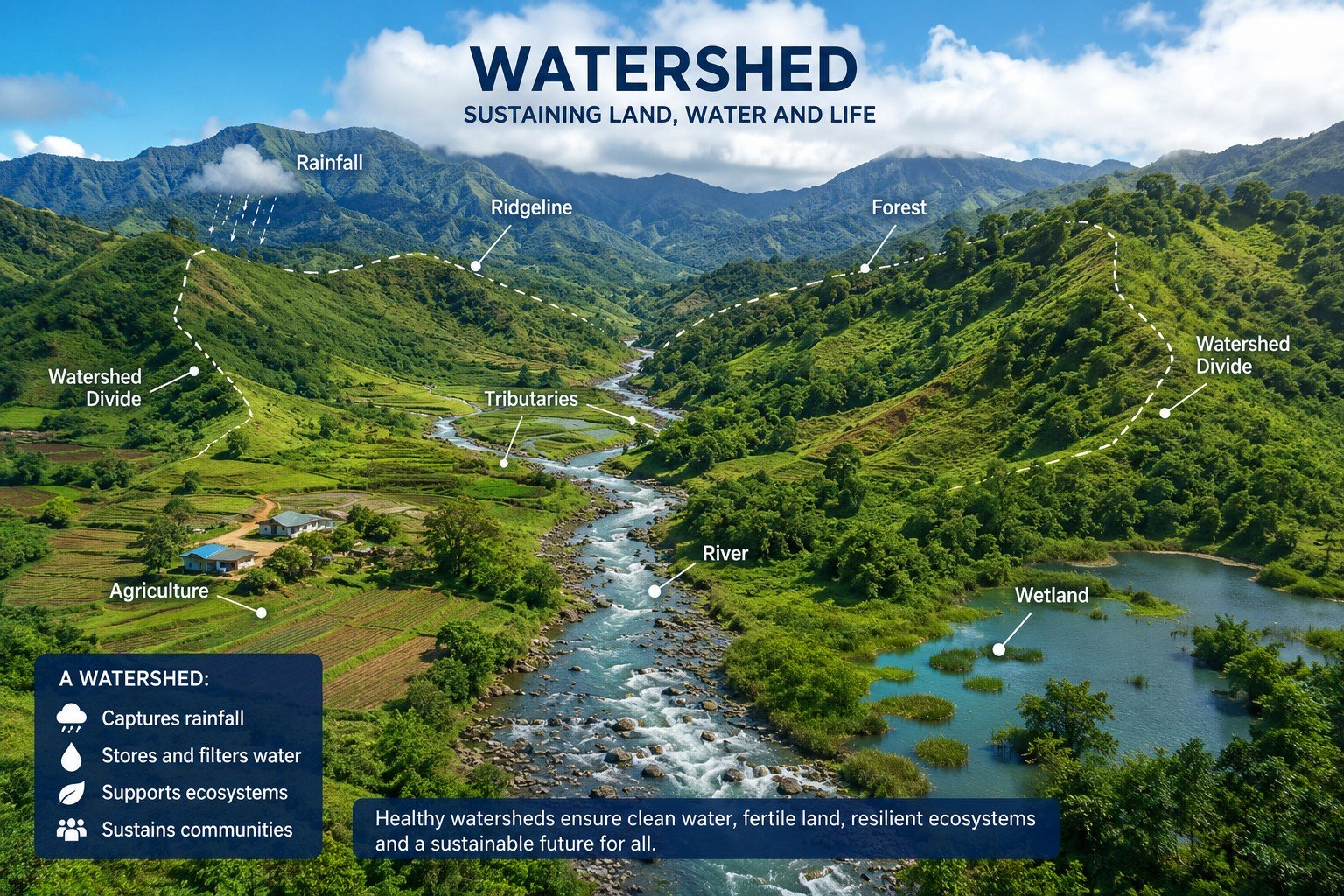
Somaliland is naturally endowed with several watersheds and drainage basins that generate substantial seasonal runoff during the Gu and Deyr rainy seasons. However, much of this water remains underutilized and eventually flows into the sea or evaporates, representing a significant lost economic opportunity.
Key watersheds such as Waaheen, Daldawan and Beer, together with major drainage basins including Biji, Daror, Ogen and Dur-Dur Cad, carry considerable volumes of surface water during rainy periods. These hydrological systems present a strategic foundation for developing large-scale water harvesting and storage infrastructure capable of supporting livestock production, fodder cultivation, irrigation agriculture and rural livelihoods.
Rather than relying primarily on groundwater extraction, Somaliland can adopt an integrated watershed development approach that captures seasonal runoff and stores it for productive use throughout the year.
Proposed Water Harvesting Schemes
- Multi-purpose earth dams along major watersheds.
- Sand dams and subsurface dams in seasonal riverbeds.
- Community water reservoirs and retention ponds.
- Small-scale irrigation schemes linked to harvested water systems.
- Check dams to slow runoff and enhance groundwater recharge.
- Valley tanks and water pans for livestock watering.
- Watershed rehabilitation through soil and water conservation measures.
Strategic Benefits
Investment in these watersheds and basins would generate multiple economic and environmental benefits:
- Reliable water supply for livestock throughout dry seasons.
- Expansion of commercial fodder production.
- Reduced livestock mortality during drought periods.
- Increased groundwater recharge and aquifer sustainability.
- Enhanced climate resilience for pastoral and agro-pastoral communities.
- Creation of rural employment opportunities.
- Increased domestic meat and milk production.
- Reduced dependence on imported feed and food products.
Proposed Somaliland Flagship Programme
National Watershed and Surface Water Development Programme (NWSWDP)
The programme would focus on the systematic development of priority watersheds including Waaheen, Daldawan and Beer, while establishing integrated water harvesting infrastructure across the Biji, Daror, Ogen and Dur-Dur Cad basins. The programme would combine water storage, fodder production, livestock commercialization and environmental restoration to create a resilient livestock economy capable of withstanding recurring droughts.
Such an initiative would transform seasonal floodwater from a largely untapped resource into a strategic asset for economic growth, food security, climate adaptation and sustainable livestock modernization and agriculture in Somaliland.
Modernizing Livestock Enterprises Under Water Stress Conditions
Who Should Lead?
Modernization requires collaboration among:
- Government institutions.
- Private sector investors.
- Development partners.
- Research institutions.
- Livestock producers and cooperatives.
- Financial institutions.
When Should Action Be Taken?
The time for action is now. Climate variability, population growth, youth unemployment, urbanization and increasing demand for quality animal products require immediate investment in resilient livestock production systems.
The trajectory toward transformative development, structural economic adjustment and meaningful long-term economic growth begins with strategic investments in water security and livestock modernization. For water-stressed countries such as Somaliland, sustainable economic transformation cannot be achieved without addressing the fundamental constraints of water availability, livestock productivity and agricultural commercialization. By unlocking the productive potential of watersheds, surface water resources and climate-smart livestock systems, the country can transition from a predominantly subsistence-based economy to a resilient, market-driven and value-added agribusiness sector. Such investments create multiplier effects across the economy by stimulating employment, attracting private capital, strengthening food security, expanding exports and enhancing rural incomes. Ultimately, the development of water infrastructure, fodder systems, feed industries and livestock value chains represents not merely an agricultural intervention but a foundation for broad-based economic transformation and national prosperity.
How Can Livestock Enterprises Be Modernized?
1. Climate-Smart Fodder Production
Traditional grazing systems should be complemented by irrigated and rainwater-supported fodder production. Drought-tolerant fodder crops such as sorghum, Sudan grass, buffel grass and forage legumes can produce high yields using relatively little water.
Example: Commercial fodder farms using harvested runoff water can provide year-round feed supplies while reducing dependence on imported feed.
2. Feed Processing and Conservation Technologies
Modern feed processing plants can convert locally available materials such as Prosopis juliflora pods, crop residues and agro-industrial by-products into nutritious livestock feed.
Feed conservation techniques including hay making, silage production and feed blocks help bridge dry-season feed shortages.
Example: Processing invasive Prosopis pods into commercial livestock feed simultaneously addresses environmental degradation and feed scarcity.
3. Improved Livestock Genetics
Rather than increasing herd sizes, producers should focus on improving animal productivity through selective breeding and improved genetics.
Example: A dairy cow producing 15–20 liters of milk daily consume significantly less water per liter of milk produced than several low-producing animals.
4. Digital Livestock Management
Digital tools can improve decision-making through:
- Animal identification systems.
- Water monitoring technologies.
- Livestock health tracking.
- Market information systems.
- Early warning drought forecasting.
These technologies reduce inefficiencies and improve resource utilization.
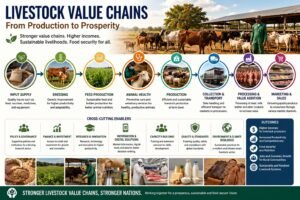
5. Commercial Livestock Value Chains
Modernization should extend beyond production to include:
- Feed manufacturing.
- Animal fattening operations.
- Dairy processing.
- Meat processing facilities.
- Export-oriented livestock systems.
Integrated value chains create higher returns while reducing production risks.
Flagship Programmes to Address Water Stress
To achieve meaningful transformation, countries should establish tangible flagship programmes that demonstrate impact at scale.
Strategy 1: National Watershed Development Programme
Develop major watersheds through water harvesting infrastructure, catchment rehabilitation and community-based management systems.
Strategy 2: Climate-Smart Fodder Production Initiative
Establish large-scale fodder production hubs linked to harvested water sources and commercial feed markets.
Strategy 3: Livestock Feed Manufacturing Programme
Promote local feed production using drought-resilient and alternative feed resources such as Prosopis juliflora, crop residues and agro-industrial by-products.
Strategy 4: Integrated Livestock Production Zones
Create livestock growth corridors that combine water infrastructure, veterinary services, feed supply systems and market access facilities.
Strategy 5: Livestock Water Security Fund
Establish a dedicated financing mechanism supporting investment in water harvesting structures, storage facilities and climate-resilient livestock enterprises.
Key Recommendations
1. Prioritize National Water Harvesting Infrastructure
Invest in watershed development, earth dams, reservoirs and surface water storage systems to secure reliable water supplies for livestock and agriculture.
2. Promote Climate-Smart Livestock Commercialization
Shift from extensive low-productivity systems toward market-oriented enterprises supported by improved genetics, feed technologies, and digital management tools.
3. Establish Public-Private Investment Partnerships
Mobilize government, donor and private-sector financing to scale water infrastructure, fodder production, feed manufacturing, and livestock value-chain development initiatives.
Holistic Livestock Solutions is a technical livestock firm contributing to build on a positive mindset for the livestock development.
# Livestock Development