
By Farhan Ahmed Yusuf
Livestock Consultant
Holistic Livestock Solutions (HLS)
🌐 Website: https://holisticlivestocksolutions.com/blog/
📞 Contact: info@holisticlivestocksolutions.com
📞 Contact: +252 63 8891055
Prologue:
Why Most Farms Struggle Silently
Across livestock farms, whether smallholder, pastoral, or semi-commercial, the biggest losses rarely come from droughts, disease outbreaks, or market crashes. They come from poor management decisions repeated daily.
“Animals Don’t Fail Farms. Markets Don’t Fail Farms. Management Fails Farms.”
In livestock production, many farmers mistakenly attribute farm failures to external factors such as animal health problems, low productivity, or fluctuating market prices. While these elements certainly influence farm performance, they are rarely the root cause of failure. The critical factor that determines the success or failure of a farm is management, the ability to plan, organize and execute farm operations effectively.
Animals are a resource, not a liability. Healthy, well-fed and properly managed livestock are capable of producing milk, meat, or offspring consistently. Losses occur when nutrition, breeding, health care, or housing are poorly managed, not because the animals themselves “fail.”
Markets provide opportunities for income. Prices may fluctuate and demand may vary, but a farm with strong management can adapt by planning production cycles, diversifying products, negotiating better sales channels, or storing products strategically. Blaming the market ignores the farmer’s responsibility to anticipate and respond to economic conditions.
Management, on the other hand, encompasses decision-making, resource allocation, labor supervision, financial control and strategic planning. Weak management leads to overstocking, underfeeding, poor record-keeping and missed opportunities. Conversely, farms with disciplined, knowledgeable and proactive management consistently outperform others, even under challenging environmental or market conditions.
In my day-to-day work with farmers, cooperatives and agribusinesses, I see the same patterns repeated: good intentions, hard labor, but weak systems. This article breaks down five farm management techniques that consistently separate struggling farms from resilient, profitable ones.
Ignore them and losses become routine.
Apply them, and farming becomes predictable.
Many people treat farming as tradition, habit, or survival activity. Successful farmers treat it as a managed production system.
Good farm management answers three questions clearly:
- What do I have?
- What do I want to achieve?
- How do I control the process between the two?
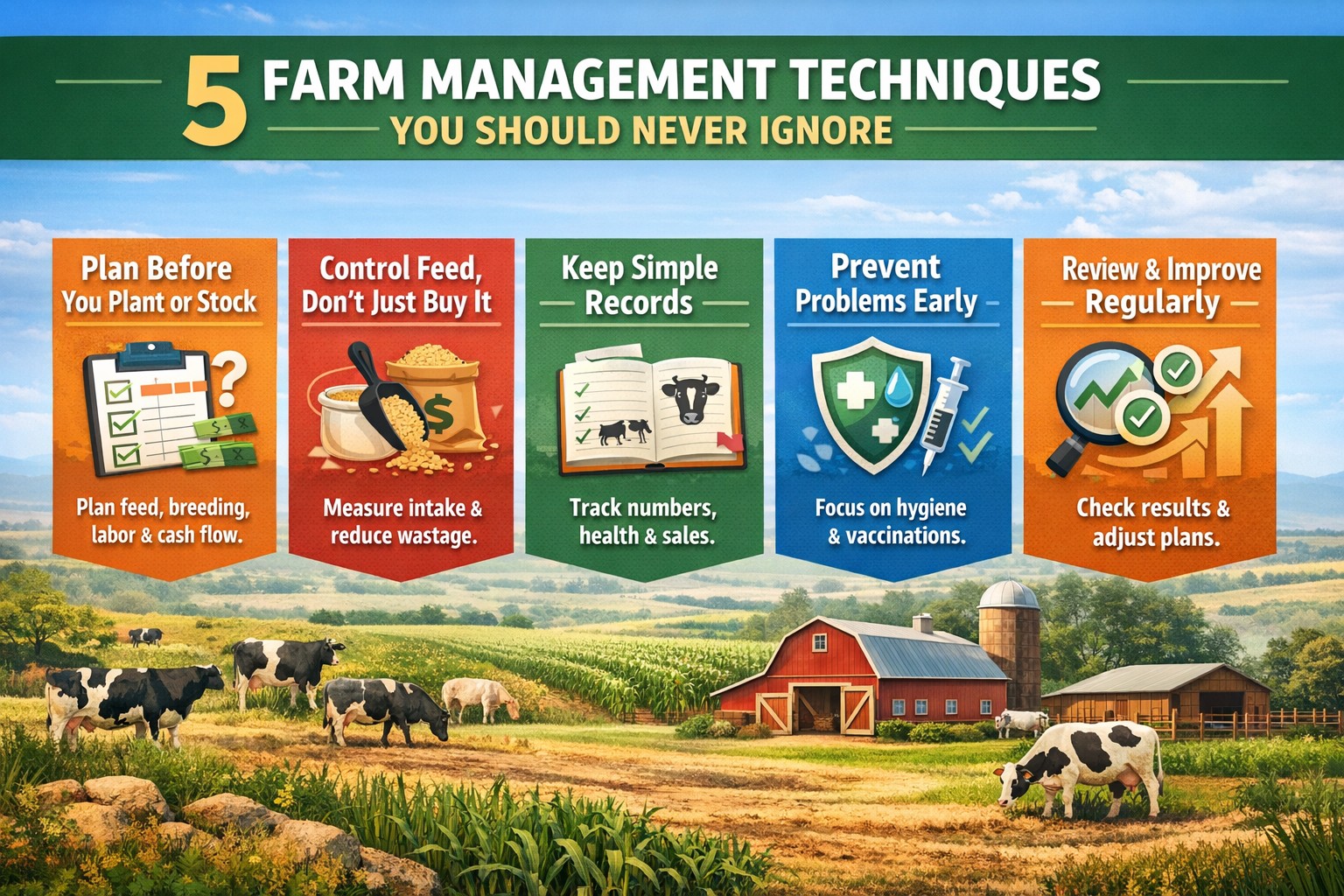
The following five techniques form the backbone of effective farm management, regardless of species, scale, or location.
1. Planning Before Stocking or Production
Technical Perspective
Planning is the process of matching resources to production targets. It includes stocking rates, feed availability, labor, water, cash flow and market timing.
Key planning elements include:
- Carrying capacity assessment
- Seasonal feed budgeting
- Breeding and production calendars
- Financial input–output projections
Everyday Farm Reality
A farmer buys 50 goats because prices look good, without calculating feed availability. Three months later, pasture declines, feed prices rise, animals lose condition and sales happen at a loss.
Another farmer plans for 30 goats based on dry-season feed reserves. Animals maintain body condition, reach market weight on time and sell at peak price.
Same environment. Different planning. Very different outcomes.
Core Lesson
Overstocking is not ambition—it is poor planning.
2. Feed Management: The Silent Profit Killer
Technical Perspective
Feed accounts for 60–70% of livestock production costs. Feed management is not about buying feed—it is about controlling intake, quality and efficiency.
Key technical controls include:
- Daily feed intake measurement
- Ration balancing by production stage
- Feed conversion efficiency monitoring
- Reduction of spillage and spoilage
Everyday Farm Reality
Many farms buy feed in sacks but never measure how much is fed per animal. Troughs overflow; animals trample feed and birds finish the rest.
In contrast, farms that:
- use measured scoops,
- fix feeding times,
- adjust rations weekly,
often reduce feed costs by 15–25% without changing feed quality.
Core Lesson
Feed wastage is hidden theft from your own pocket.
3. Record-Keeping: From Guesswork to Control
Technical Perspective
Records transform farming from intuition-based to data-driven decision-making. At minimum, records should track:
- Animal inventory
- Births, deaths and sales
- Feed usage
- Health treatments
- Costs and income
These records allow calculation of:
- Mortality rates
- Growth performance
- Cost per animal
- Profit per production cycle
Everyday Farm Reality
A farmer believes goats are profitable, until records show mortality is 18% and treatment costs exceed sales margins.
Another farmer, using a simple notebook, identifies poor-performing animals early and removes them, improving herd productivity within one season.
Core Lesson
If you don’t write it down, it doesn’t exist.
4. Preventive Health Management Over Emergency Treatment
Technical Perspective
Preventive health focuses on risk reduction, not crisis response. It includes:
- Vaccination schedules
- Parasite control programs
- Clean water systems
- Housing hygiene
- Biosecurity controls
Preventive systems reduce:
- Mortality
- Treatment costs
- Productivity losses
- Disease spread
Everyday Farm Reality
Farmers often call for help only when animals are already dying. Treatment becomes expensive, outcomes are poor and losses are blamed on “bad luck.”
Farms with simple prevention routines, clean troughs, isolation of sick animals, scheduled vaccinations experience lower mortality and higher growth rates year after year.
Core Lesson
Medicine treats symptoms. Management prevents losses.
5. Continuous Review and Adjustment
Technical Perspective
Farm systems operate in changing environments—climate, markets and input costs shift constantly. Regular review ensures the system adapts.
Monthly or seasonal reviews should assess:
- Production targets vs actual results
- Feed efficiency
- Cost overruns
- Health and mortality trends
Everyday Farm Reality
Many farmers repeat the same mistakes every year because no one stops to ask: Why did this fail?
Farms that review performance, even informally identify problems early and correct course before losses compound.
Core Lesson
Experience is not years spent farming; it is lessons learned and applied.
Closing Thoughts: Farming Rewards Discipline, Not Effort Alone
Hard work is essential, but discipline is decisive. Farms succeed when management becomes intentional:
- Plans replace assumptions
- Measurements replace guesses
- Prevention replaces reaction
- Review replaces repetition
The difference between a struggling farm and a thriving one is rarely luck. It is management.
About the Author
Farhan Ahmed Yusuf is a livestock consultant and a lead contributor at Holistic Livestock Solutions (HLS), a firm dedicated to strengthening livestock productivity, farm management systems and agribusiness capacity across diverse production environments.
📍 HLS supports farmers, cooperatives and institutions through training, advisory services and strategic livestock planning.